Monday, February 25, 2013

A foodie goes to Macau ( Part 1 )


Macau known as the " Las Vegas of Asia " has been a tourist destination of a lot of people who love to gamble. Macau was a former Portuguese Colony and now a Special Administrative Region in China just like Hong Kong. It has both the influences of Chinese and Portuguese Culture. 90% of the people residing here are Chinese and the rest are mixed races called Macanese ( Chinese with a mix of Portuguese ). There are lots of hotels on the island where you will be able to find one that is affordable for your budget. Compared with its sister city Hong Kong, Macau is a small place, but there are lots of places to visit,  good food to taste and things to do in Macau. The best way to get around Macau if you don't want to walk is to grab the free hotel shuttles. Their shuttle buses return to the main bus terminal and you can catch a different hotel bus to reach the opposite side of town.


In my recent trip to Macau, I traveled with my cousin and her best friend who are food lovers like me. We stayed at The Buckingham which is located very near the Old Taipa Village. Everyday we would walk to Old Taipa Village square to catch a hotel shuttle bus to bring us to Galaxy Hotel.

Since we do not gamble, we enjoyed our stay experiencing the excellent food Macau has to offer. I was able to taste Portuguese, Macanese and Cantonese cuisine.

Our first stop was a tiny Portuguese restaurant called CORTO. It's a small restaurant along Rua do Regedor located in the Old Taipa Village. As we entered the restaurant  I felt like I was in someone's kitchen. The ambience was very cozy. After glancing at their menu ( most menus in the restaurants have a picture of the dish for quick reference ) we had:

Baked Clams with wine sauce and lemon.


Grilled Macau Sole with a tangy tamarind sauce -- a must try in this restaurant.


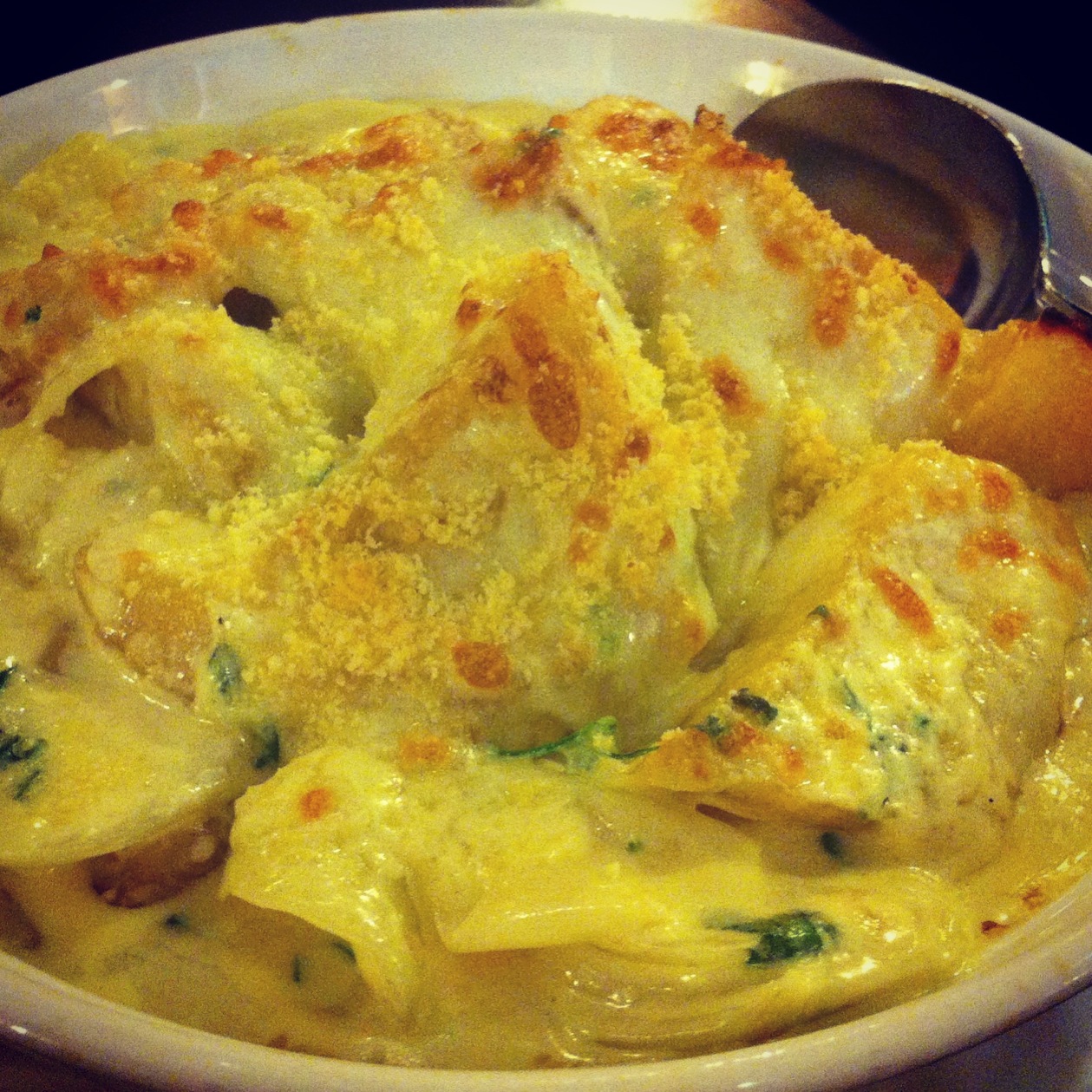
The best dish which I thought was really a clincher was the Baked Bacalao with cheese ( Bacalao or Bacalhau com Natas ). This dish is one of the most popular cod dishes that you'll find served at traditional Portuguese restaurants. Bacalhau com Natas is like a lasagna made of cod. It includes layers of cod fish, onions, dices fried potatoes, and lots of creamy deliciousness.

After lunch we walked to KOI KEI Bakery on Rua de Cunha. I was able to try their famous Portuguese egg tarts ( or pastel de nata ).


These Portuguese egg tarts was one of my favorite desserts during this trip.  It is a traditional Portuguese custard pastry that consists of custard in a creme brulee-like consistency caramelized in a flaky puff pastry case. It is best eaten while it still warm, it was so delicious!!


Koi Kei is a great bakery offering a variety of candies, almond cookies, lots of varieties of beef and pork jerky. It is so very popular with the Hong Kongese, Taiwanese and Chinese -- and it can be a mess trying to get inside when it is busy. But that is part of the shopping experience !!! They have " free tasting " -- you can try some of the many cake/pastry samples they have. For beef jerky lovers --there is always a lady stationed at the front near the meats who is eager to let you try as many types as you like. My favourite was the little piglet jerky and the wild boar jerky.

As for the almond cookies, they are very popular with the locals and tourists -- I found them too chalky for my taste preferences. In Manila -- we have a local cookie ( called araro cookies ) that tastes similar to these cookies. I personally enjoyed them with coffee, complimenting their normal chalky texture with a bit of moistness. I love almonds and these little cookies always taste good to me.

Later that day we took the hotel shuttle and went to the Senado Square.  It is Macau’s Famous Landmark, together with it is the “Street Of Happiness” or also known popularly as “San Ma Lo”.


Aside from its old historic buildings, what distinguishes Senado Square is the wave-patterned mosaic tiles of black and white stones brought to life by Portuguese experts. The Senado Square is considered as one of the most popular historical sites in Macau. Situated at the heart of  Macau Peninsula, this UNESCO World Heritage Site was the seat of power for the Portuguese as they ruled over the country for more than a hundred years. Visitors can also find a large array of souvenir shops. The square is surrounded by a group of colorful buildings painted in white, yellow, pink, green, or brown. Most of them are three-storey buildings with arched windows, doors and corridors.

As you walk down the pedestrian-only streets, the smell of meat, savory noodle soup, freshly baked bread and pastries would greet your senses.  It is an exhilirating experience. There were long queues at the fast food outlets -- To get a cup of coffee at Starbucks or Gloria Jean would take 30 minutes after you place your order at the counter. The whole place was filled with people --- you could not even get a seat at the square itself...


Thursday, November 22, 2012

Anneyong-haseyo Korea ( Part 2 ) Exploring Jeju Island


Today let me take you with me to Cheonjiyeon falls.


Cheonjiyeon  is also known as  “God’s Pond” or " the " Pond of Heaven's Emperor ". According to our guide, Cheonjiyeon derived its name from a legend that seven fairies who served the King of Heaven descended to this water source on cloud stairs, then bathed in its clear waters.


The park’s walking path takes you right to the falls. If you love nature, water, and stunning views, this is the place to be. Be sure to bring your tripod to capture all the glory.


Actually, Cheonjiyeon falls is a three-tiered waterfall.. The first fall looked like a large U -shaped grotto with a massive cascade of water plunging deep into “The Pond of God” ( the second level ).  During the winter months, this first waterfall may be nothing more than a mere trickle, but that doesn’t diminish the area’s beauty, but rather enhances it. The Cheonjiyeon falls is home to more than 400 individual species of plants and animals. 


After taking a brief rest, we went to the second falls ( we did not go to the third falls anymore ) -- This path takes one into the surrounding wooded areas and allows you to embrace nature. Walking along the wooden path, you can see several streams, flowers, and if you’re lucky, a few animals just as curious about you, as you are about them. Photographic opportunities abound along the path and at the waterfalls.

We had a seafood lunch at Sinwoosung.


We had one big steaming seafood pot filled with the best catch of the day.... Scallops, oysters, mussels, clams, succulent shrimps, very sweet tasting abalone, and sea urchin. In Korea the side dishes and rice that come with your main meal are always refillable. They also give you a free bowl of seaweed soup.


 After lunch we drove to the Seongeup Folk Village.


This is a small and nice village that re-animates the life of the Koreans in the past. There are many things to see and learn to know how the people lived in the old days. I was hoping to get a picture of the natives in their national clothes but I was not able to see any of them. According to our guide, the natives are quite camera-shy and they would rather stay inside their homes and prepare meals for their families.


Jeju is famous for the unique fences around the village houses. Reaching up to just around knee height, the fences were probably more as an obstacle to prevent farm animals from wandering into the garden. However, the fences have another socio-cultural role. It is visibly seen every time you see a home anywhere in the island. These bars act as a sign of the owner's whereabouts. Usually there will be 3 bars up. One bar up means " back in a while ". Two bars up mean " out for the whole day ". Three bars up mean " gone traveling ".


In the photo above you will see there are 3 bars at the gate.... When all 3 bars are put down, it indicates that the home owner is at home and you are welcome.


This village is a must see, especially if you enjoy architecture. Go back in time and experience the traditional Jeju way of life in this preserved agricultural village. The thatched roof and lava rock wall homes have been passed down through the generations and locals still inhabit these homes.


Sunday, November 18, 2012

Anneyong-haseyo Korea ( Part 1 ) Jeju Island


After months of travel preparations and research on where/what to go, Edith and I decided to go and visit Korea. Edith had specific places she wanted to see in Korea and I wanted to take photos. Our first stop from Manila was Jeju Island. I heard so much about Jeju after it won as one of the new 7 wonders of the world--- I had to go and see it for myself. We decided to go on a private tour to Jeju ( we had our own car and a tour guide ) -- so we could travel on our own pace. The price for a private tour is a lot more but it was worth it.  Come with me while I discover the beauty of Jeju Island.......


Jeju Island is one of the nine provinces of Korea and has 2 UNESCO sites ( Mount Halla and Seongsan Ilchibung ). It has 4 seasons and an average yearly climate of 15 degrees during the day time and drops to 8 degrees in the evening. This island is very windy,  I suggest that you dress appropriately for the Jeju weather.


Every visitor to Jeju is sure to see their fair share of Dolhareubang ( "old grandfather stone statues” ). Sometimes serious-looking, sometimes almost comical, these statues dot the landscape and have become one of the most widely-recognized symbols of the island. According to Jessica, our tour guide, the Dolhareubangs are also " fertility " gods to the Koreans. Women who wishes to have a son would rub the nose of the dolhareubang.

We were met at the Jeju international airport by our guide, Jessica, a very nice Korean girl who was very articulate and always had a friendly smile. She accompanied us to our hotel and gave us our schedule for the next day.


After breakfast we went to Seongsan Ilchibung Peak - one of the Unesco Heritage Site in Jeju. Ilchibung Peak ( is also known as the Sunrise Peak ) is actually a dead volcano on the eastern-most point of Jeju island. According to our guide, you need to walk up the peak which takes 40 minutes depending on your ability. When we arrived at our destination there were so many tourists lined up and each one of them ready to walk up to the peak. We took a slow uphill walk to the top --- stopping most of the time to catch our breath and to take photos.


The climb up may be tiring-- yes, it was worth it. Be careful of strong winds so hold on tight when climbing. There are handrails along the way for you to hold. The hike can be very strenuous for some and the steps at times are uneven and slippery. Go as far as you can. Overall, the trail was well maintained, so even though there was a lot of traffic, you don't feel like it was too congested or dirty. There were stone steps all the way up, with a few viewing platforms on the way where you can stop and rest for a while. Once reaching the top you will be ushered to a wooden platform overlooking the extinct volcanic crater.


The view at top was simply awesome!!!  however, the view along the way were also good. I suggest that you bring your panoramic view lens or fish eye lens. A tripod will be a terrific idea if you are fit to carry it all the way to the top.


Finally ----- we reached the top! The view was something I could not describe in words at the top. It was a very memorable journey for us. Ilchibung or Sunrise peak is among the highlights when visiting Jeju Island and it's A MUST place to visit. We took a lot of pictures at this place.


Beautiful scenery and fresh air greets you once when you reach the top of the peak. You can see the   stunning scenery surrounding the island from all angles. The view of the volcano crater which is covered by greenery is simply awe-inspiring.